
 (754) 289-6645
 Call Us Now
 Email Us Now
TL;DR:
A U.S. visa extension may allow certain nonimmigrants to remain in the United States beyond their current authorized period of stay.
Your eligibility and application process depend on your visa classification and circumstances.
- USCIS recommends applying at least 45 days before your authorized stay expires.
- Many applicants use Form I-539, while certain nonimmigrant workers use Form I-129.
- E-1 treaty traders and E-2 treaty investors may qualify for extensions of stay if they continue to meet applicable requirements.
- Your visa expiration date and authorized period of stay are not necessarily the same.
- Some travelers, including those admitted under the Visa Waiver Program, generally cannot apply for an extension.
If you are in the United States on a temporary visa and you require more time to conduct business, work, travel, or complete another permitted activity, you may be able to extend your stay.
But you should be aware that U.S. visa extensions are not automatic. Your options ultimately depend on your nonimmigrant classification, whether you have maintained your status, and when you apply.
It is, therefore, crucial to understand these requirements well before your authorized stay expires so you can determine next steps and avoid immigration issues that could affect future travel to the United States.
What is a U.S. Visa Extension?
“Visa extension” is a commonly used term, but technically, many people are applying to extend their authorized stay or nonimmigrant status rather than extending the visa in their passport.
The U.S. Department of State explains that a U.S. visa allows a foreign national to travel to a port of entry and request permission to enter.
That being said, having a visa neither A) guarantees admission nor B) determines how long you can legally remain in the country.
Once you enter the United States, your Form I-94, when applicable, typically shows your admission classification and how long you are authorized to stay.
That distinction is important because the expiration date printed on your visa and the expiration of your authorized stay can actually be different.
Who Can Apply for a Visa Extension in the USA?
Eligibility depends on your nonimmigrant classification and whether you have followed the conditions of your admission.
According to USCIS guidance for extending your stay, you may generally apply if:
- You were lawfully admitted to the United States with a nonimmigrant visa.
- Your nonimmigrant status remains valid.
- You have not committed crimes that make you ineligible for a visa.
- You have not violated the conditions of your admission.
- Your passport is valid and will remain valid for the duration of your stay.
Not every temporary visitor is eligible, however. For example, USCIS explicitly states that people admitted through the Visa Waiver Program, as well as certain C, D, K, and S nonimmigrants usually cannot apply to extend their stay.
You should be aware that there are also many different nonimmigrant visa categories. Extension eligibility requirements depend on the purpose of your stay and your classification, which can get confusing.
That’s where getting Visa extension help from a reputable immigration attorney can be extremely beneficial.
How to Apply for a U.S. Visa Extension
There may be variations to this process depending on your nonimmigrant classification, so you’ll want to review the correct steps with an attorney before taking any action.
That said, you can generally expect to take the following steps:
- Confirm your status and expiration date. Review your passport, visa, Form I-94, and other immigration documents.
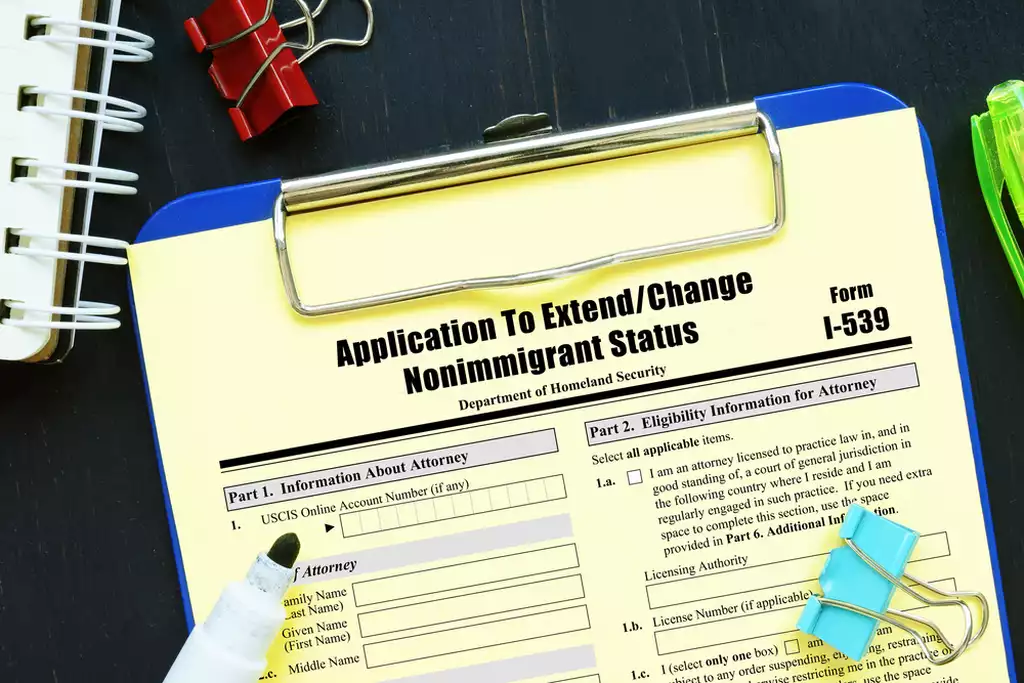
- Determine the correct form. Extensions are generally requested using Form I-539, Application to Extend/Change Nonimmigrant Status, or Form I-129, Petition for a Nonimmigrant Worker, depending on your classification.
- Gather supporting documents. You may need your passport, Form I-94, financial records, business or employment documentation, and evidence that you continue to meet the requirements of your status.
- File on time. Submit the appropriate forms, evidence, and fees according to current USCIS requirements.
After filing, USCIS will generally do one of three things:
- Approve your request
- Deny your request
- Ask for additional evidence
Filing an application is not a guarantee that you will be granted a visa extension.
Common Visa Extension Mistakes to Avoid
Prior to applying for a visa extension, you should be aware of these common mistakes people often make so that you can avoid making them yourself during the application process:
- Applying too late: USCIS recommends filing at least 45 days before your authorized stay expires.
- Confusing visa validity with authorized stay: Your visa’s expiration date does not necessarily determine how long you can remain in the United States.
- Using the wrong form: The filing process varies by nonimmigrant classification.
- Assuming everyone can extend: Travelers admitted under the Visa Waiver Program generally cannot apply for a standard extension.
- Failing to show continued eligibility: Supporting evidence should demonstrate that you continue to meet the requirements of your classification.
Get Help with Your U.S. Visa Extension Request Now
Visa extension requirements depend on your nonimmigrant classification and individual circumstances.
For E-1 treaty traders and E-2 treaty investors, an extension may also require demonstrating that you continue to meet applicable business or investment requirements.
Regardless of your situation, the Law Offices of Carla A. Anzaldi can help you understand your options and navigate the appropriate filing process.
Discover our temporary non-immigrant visa solutions to learn how our immigration attorneys may be able to help you with your visa extension.